 National Institute of

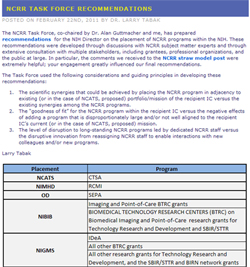 I have previously noted that NIH has proposed creating a new entity, the National Center for Advancing Translational Sciences (NCATS), to house a number of existing programs relating to the discipline of translational science and the development of novel therapeutics. Plans for NCATS have been coupled to a proposal to dismantle the National Center for Research Resources (NCRR), in part because the largest program within NCRR, the Clinical and Translational Science Awards, would be transferred to NCATS and in part because of a statutory limitation on the number of institutes and centers at NIH.
NIH leadership established a task force to determine the placement of NCRR programs within NIH. This group initially developed a “straw model” for discussion and more recently submitted its recommendations to the NIH Director. The recommendations include transferring the Institutional Development Award (IDeA) program and some Biomedical Technology Research Centers and other technology research and development grants to NIGMS at the beginning of Fiscal Year 2012.
As you may be aware, I have expressed concerns about the processes associated with the proposal to abolish NCRR. I hope it is clear that my concerns relate to the processes and not to the NCRR programs, which I hold in very high regard. This opinion is also clearly shared by many others in the scientific community, based on comments on the Feedback NIH site and in other venues.
While there are several additional steps that would need to occur before organizational changes could take place, we at NIGMS are already deepening our understanding of the NCRR programs through meetings with NCRR staff and others directly familiar with the programs. We welcome your input, as well, particularly if you have experience with these NCRR programs. Please comment here or contact me directly.
I have previously noted that NIH has proposed creating a new entity, the National Center for Advancing Translational Sciences (NCATS), to house a number of existing programs relating to the discipline of translational science and the development of novel therapeutics. Plans for NCATS have been coupled to a proposal to dismantle the National Center for Research Resources (NCRR), in part because the largest program within NCRR, the Clinical and Translational Science Awards, would be transferred to NCATS and in part because of a statutory limitation on the number of institutes and centers at NIH.
NIH leadership established a task force to determine the placement of NCRR programs within NIH. This group initially developed a “straw model” for discussion and more recently submitted its recommendations to the NIH Director. The recommendations include transferring the Institutional Development Award (IDeA) program and some Biomedical Technology Research Centers and other technology research and development grants to NIGMS at the beginning of Fiscal Year 2012.
As you may be aware, I have expressed concerns about the processes associated with the proposal to abolish NCRR. I hope it is clear that my concerns relate to the processes and not to the NCRR programs, which I hold in very high regard. This opinion is also clearly shared by many others in the scientific community, based on comments on the Feedback NIH site and in other venues.
While there are several additional steps that would need to occur before organizational changes could take place, we at NIGMS are already deepening our understanding of the NCRR programs through meetings with NCRR staff and others directly familiar with the programs. We welcome your input, as well, particularly if you have experience with these NCRR programs. Please comment here or contact me directly.Archived: February 23 Teleconference on NIH Organizational Changes
February 11, 2011
Continue Reading
Archived: New Blog from NIH Extramural Research Chief
January 25, 2011
Continue Reading

Archived: Comment on Proposed NIH Organizational Changes via New Feedback Site
January 19, 2011
Continue Reading
 NIH recently launched a new site for communication with the scientific community, http://feedback.nih.gov/. The site has already been quite active, since it requests input on a proposed National Center for Advancing Translational Sciences (NCATS) and a proposed institute focused on substance use, abuse and addiction research.
Archived: PSI Tools for Your Lab
January 12, 2011
Continue Reading
 Over the course of its 10-year existence, the Protein Structure Initiative has supported the development of new technologies and methods that improve the throughput of protein structure determination. Many of them apply to the production of purified proteins for functional and structural studies, and you don’t need access to major research centers to use them.
Archived: New Online Evaluation Resource
October 1, 2010
Continue Reading
Archived: New Distributor for Knockout Mice
August 31, 2010
Continue Reading
 NIGMS (and other NIH) investigators previously have been able to obtain over 2,500 knockout mouse strains at a negotiated cost from Lexicon. These mouse strains are no longer available directly through Lexicon.
Archived: Maintaining “Legacy” Scientific Resources
August 23, 2010
Continue Reading
Archived: Impact Score Paragraph in Summary Statements, Plain Language in Public Sections of Grant Applications
August 11, 2010
Continue Reading

Archived: Electronic Awards Administration
July 14, 2010
Continue Reading